As one of the highly popular technologies for scalable infrastructure management, Kubernetes has become a major topic in container orchestration and developing cloud-native applications. It is used by many developing platforms for automation of the deployment and management of distributed workloads.
Because of its widespread popularity, there is an assumption that all high-traffic websites eventually move toward utilizing container clusters and orchestration; however, this is not necessary.
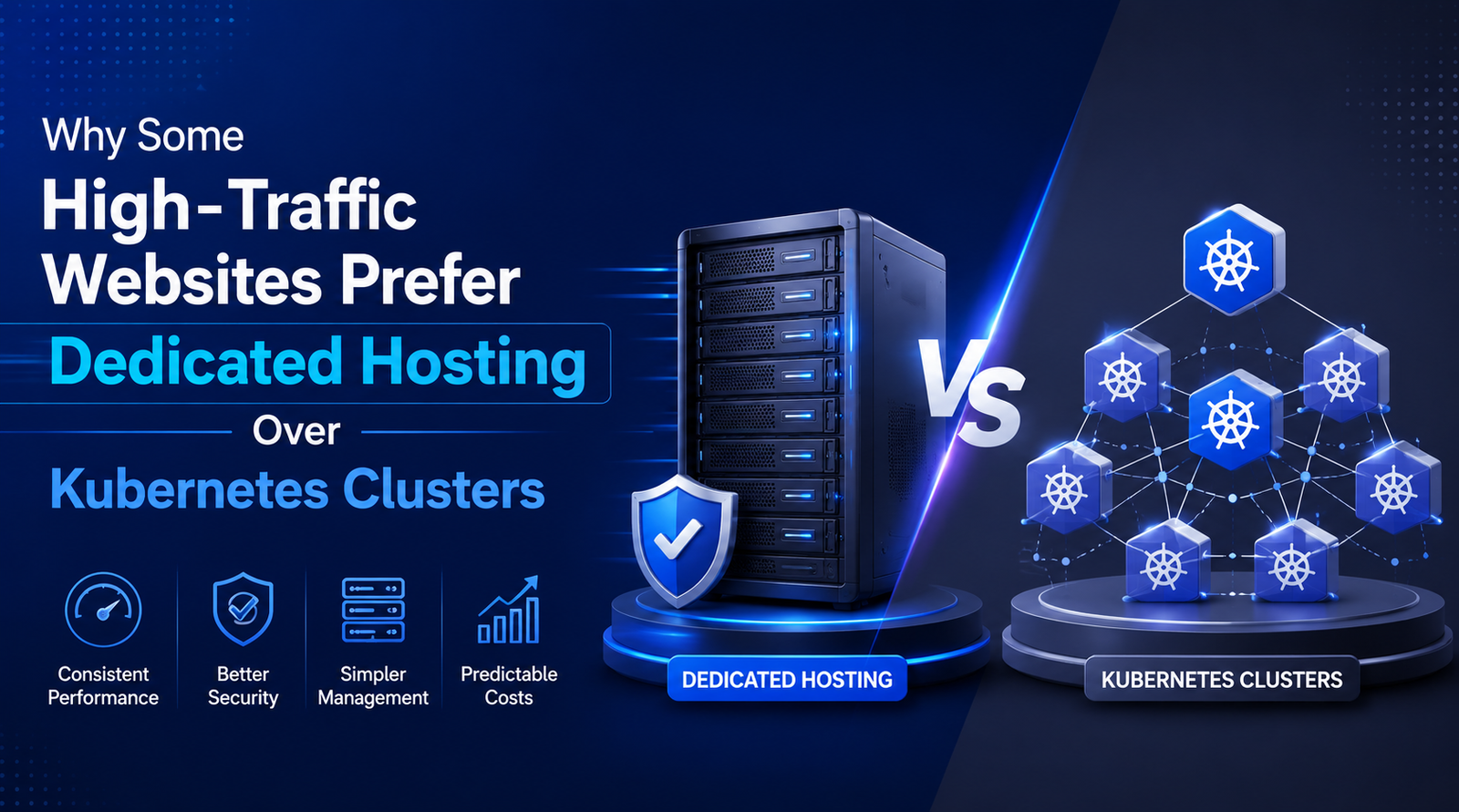
There are numerous high-traffic websites that utilize dedicated server hosting pricing environments instead of a Kubernetes-based cluster. This isn't due to a reluctance to move toward modern infrastructure. In simple terms, the best dedicated server hosting provider works better for certain workloads from an operational standpoint than a container environment.
Simplicity for operational stability
Kubernetes environments are effective but complicated due to high management levels throughout a cluster. This includes orchestration layers, networking setups, schedulers for containers, service discovery systems, monitoring systems, and managing persistent storage.
If an application does not need high scaling dynamically (microservices), then Kubernetes clusters create an unnecessary burden from operational overhead.
Dedicated hosting spaces are much more straightforward. The application will run directly on allocated hardware without any additional orchestration layers. This has fewer moving parts and therefore a higher probability of failing.
For some companies, the simplicity of dedicated hosting can improve reliability more efficiently than a virtualized environment.
Predictable workloads
Not every application with high traffic experiences unpredictable scaling. There are many websites that consistently generate high levels of traffic but exhibit consistent workload characteristics.
In these circumstances, dedicated hosting allows for fixed resource allocations. It guarantees 100% of the allocated CPU, memory, disk space, and network resources to an application.
The Kubernetes environment was created with the intention of spreading load factors to other workers (nodes). While that flexibility is great, a consistent workload doesn't need that orchestration level. Thus, for such applications, the performance through a dedicated hosting environment is much greater.
Bare-metal performance
With container orchestration, the overhead increases by adding layers between an application and its underlying hardware. In addition to the actual application and data, you also have the containers, networking overlays, software, and hardware resources allocated (by orchestration agents) and resource scheduling systems.
When dedicated servers are provisioned, applications get closer to the underlying hardware without the added overhead of orchestration. Organizations with high-traffic websites interested in maximum efficiency of performance wisely choose to operate in dedicated environments.
Predictable infrastructure costs
Many Kubernetes clusters are hosted within cloud-based environments that allow for dynamic scaling depending on utilization. The dynamic scaling of infrastructure creates variable billing cycles.
Reliable dedicated host environments like MilesWeb have set pricing that is based on fixed monthly rates. An organization knows exactly how much processing capacity it is paying for, regardless of fluctuations in infrastructure.
For organizations with a predictable workload, dedicated hosting is a better solution. It offers systematic budgeting and operational costs compared to the unpredictable nature of a Kubernetes deployment.
Needs of monolithic applications
Kubernetes helps automate scaling and deployment management for microservices. However, many websites are built using a non-modular configuration and don't need this orchestration.
Moving a monolithic application to a Kubernetes environment led to many architectural changes without any operational benefits. In this situation, using dedicated hosting allows the application to continue running without making unnecessary changes to the current architecture.
Troubleshooting issues
Troubleshooting problems in a large cloud-based environment is very difficult. When infrastructure-based issues arise, there are multiple causes, including issues related to container networking, orchestration policy, service meshes, or cluster-based dependencies.
Dedicated environments reduce the complexity of troubleshooting by providing an easier-to-manage infrastructure. Identifying poor application performance areas becomes easy with the fewer layers of infrastructure. Thus, for businesses that prioritize operational clarity, dedicated hosting provides a practical advantage of better visibility and improved response times.
Security and compliance
For reasons such as compliance, data governance, or internal security policy, industries require a physically separate infrastructure for complete isolation between different regulated environments.
While Kubernetes environments can provide a high level of security, some applications still have additional compliance issues due to the multi-tenant nature of the underlying cloud orchestration platform. In contrast, dedicated servers provide a dedicated physical or logical environment for those applications that have stringent separation and boundary definitions.
Dedicated infrastructure provides a higher level of control over hardware allocations, network segmentation, and access management. As such, dedicated infrastructure can support strongly regulated organizations better than Kubernetes.
Getting a suitable environment
The widespread utilization of Kubernetes establishes that any and all growing applications will eventually need an orchestration platform. However, the suitability of infrastructure for any particular application is determined by operational requirements, rather than by current trends within an industry.
In some cases, dedicated hosting is much more effective for workloads that require stable performance, operational simplicity, predictable resource allocation, and reduced infrastructure complexity. High levels of traffic alone do not justify the use of distributed orchestration systems.
Closing Summary
Kubernetes clusters provide amazing scalability and flexibility for modern-day distributed applications. But some high-traffic websites don't capitalize on that complexity.
Companies operating under stable workloads, using monolithic architectures, having performance-sensitive applications, and having predictable operational needs benefit from dedicated hosting with its practical and efficient solution.
Infrastructure decisions should be based on workload behavior and operational priorities rather than simply riding the newest technological wave. In many cases, when hosting a website with high amounts of traffic, the stability, clarity, and performance of a dedicated hosting infrastructure best cater to these types of websites.
Need Help Improving Your Website Speed?
At Infini Growth Media, we help businesses build high-performance websites, optimize loading speed, improve SEO, and choose the right hosting solutions for long-term growth.